
The First 30 Days After a Serious Injury: Records and Decisions That Matter
The First 30 Days After a Serious Injury: Records and Decisions That Matter: practical guidance for organizing relevant information.
The days after a serious injury can feel fragmented: medical appointments, work disruption, calls from insurance representatives and practical questions about transportation or family responsibilities. There is no single timeline that fits every incident, and urgent health needs always come before paperwork. Once immediate safety and treatment are addressed, however, a clear record of events and expenses can help you understand what happened and explain your concerns in a legal consultation. This guide outlines a calm, realistic first-month approach.
How to use this guide: Start with immediate safety or deadline needs. Then use the sections as a recordkeeping and consultation checklist. They describe practical information-gathering steps, not individualized legal or medical advice.
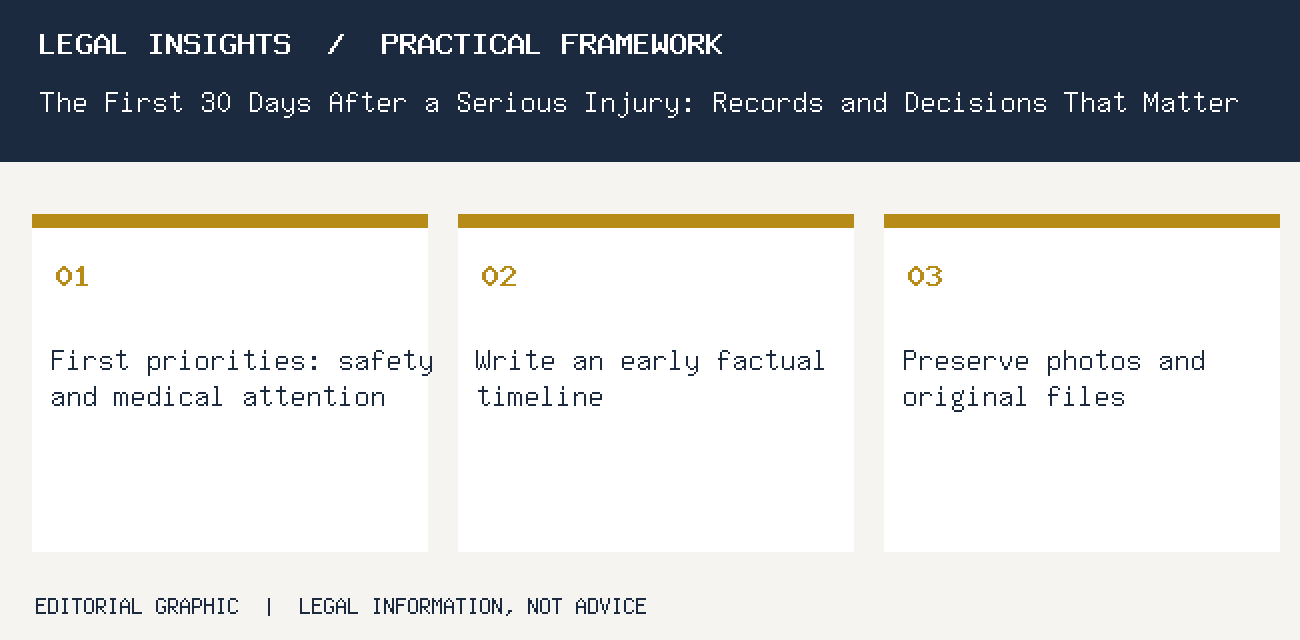
First priorities: safety and medical attention
Health and safety take priority over photographs, financial questions or communications with a claims representative. Focus on the narrow question rather than predicting the whole case. What happened, who observed it, what document is available, and what might explain the same event differently? A clear answer to those questions is more useful than an unsupported conclusion about fault.
Seek appropriate medical evaluation, follow clinician instructions and document urgent steps when it is safe to do so. Reliable records are easier to use when a neutral reader can find the original source of each assertion. Write the date beside the event, identify who provided the information, and distinguish a document from your memory of its meaning. The goal is clarity, not creating a more dramatic account.
Someone evaluated after a collision may need follow-up care even if the immediate symptoms seem limited. A careful account should identify the particular evidence, who supplied it and whether the sequence is agreed. If the source is incomplete, record the limitation instead of assuming the most favorable explanation is necessarily true.
Do not delay treatment to obtain a perfect evidence file or try to diagnose an injury from online material. Consider which immediate action is appropriate and which issue needs a professional review. Keep decisions traceable to a source, note follow-up dates and avoid irreversible steps on the strength of an unverified assumption.
Write an early factual timeline
Details about sequence, weather, road conditions, equipment or statements may become hard to recall as days pass. Keep a working copy for collaboration and preserve the authentic record separately. Mark estimated dates, missing material and later amendments plainly. This makes follow-up easier when several people or institutions contribute information at different times.
Write what you remember in chronological order and label uncertain details as estimates. Urgent decisions can coexist with uncertainty. If safety, treatment or a formal notice needs attention, identify that first. Other questions may require follow-up documents or professional review. A working checklist helps prioritize tasks without claiming that every issue can be solved from the first file.
A person may remember the time of a call more reliably from a phone record than from memory several weeks later.
Do not fill unknown details with assumptions or alter an earlier note to make it look contemporaneous.
Preserve photos and original files
Relevant evidence can include scene photos, damage, clothing, equipment, vehicle positions, conditions and digital recordings. The relevant facts may change as new records become available. Record the current understanding and the source for it; revisit the issue when evidence is added. A practical timeline should help communication, not lock you into a claim before review.
Save original files, capture location and date where available, and create a separate working copy for sharing. Information about a person’s health, financial situation or private communications deserves careful handling. Share only what is appropriate through secure channels, and avoid unnecessary public circulation. Preserving a record is not the same as making it available to everyone who asks.
A photo showing a damaged sidewalk should retain context about where it was taken and when.
Avoid publicly posting sensitive material or editing the only original recording.
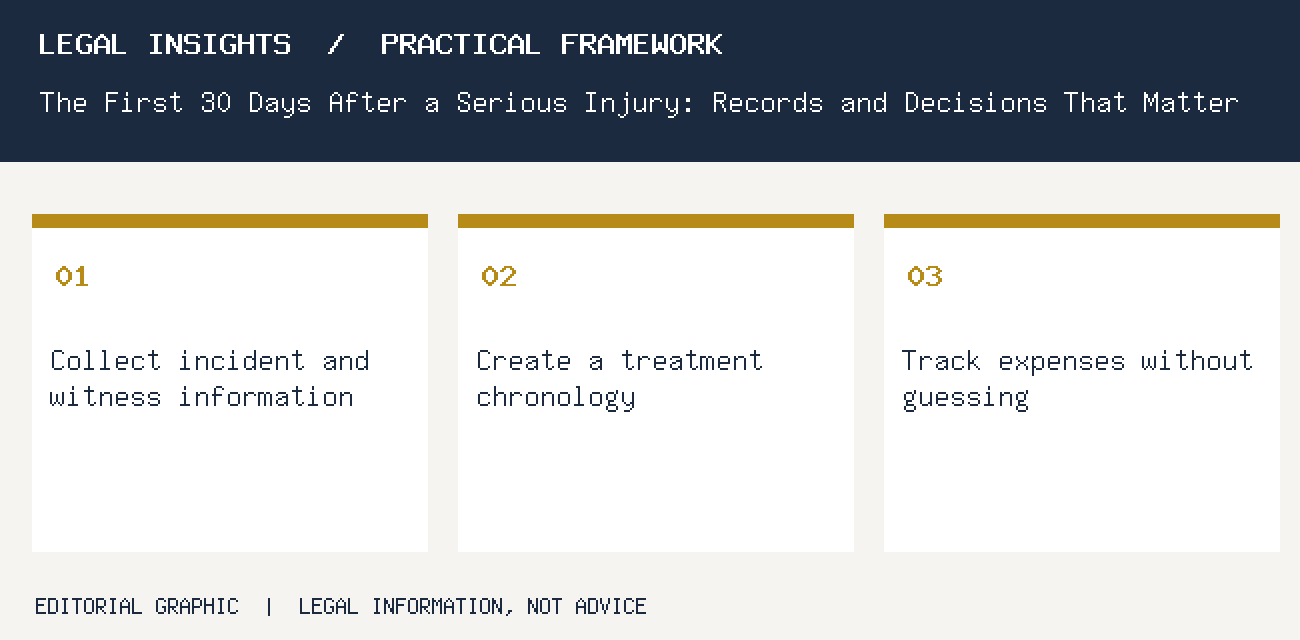
Collect incident and witness information
Reports, contact details and independent observations may help clarify events that no single person saw fully. Think about the decision this information supports. It may help identify a provider, answer an insurer, preserve evidence, assess a contract or prepare for counsel. When an action could be difficult to reverse, obtain appropriate advice first.
Record reporting agency, report number if known, potential witnesses, and any lawful evidence source. A useful summary can acknowledge missing facts without weakening the commitment to accuracy. Write unknown where the timing or source cannot presently be verified. If an estimate is necessary, label it as such. Later corrections should be documented rather than replacing the original note.
A store might have footage that is routinely overwritten before anyone asks about preservation.
Do not confront witnesses or assume a police report alone establishes every fact or legal conclusion.
Create a treatment chronology
A record of appointments and health-related limitations can support clear communication with medical and legal professionals.
Track dates, providers, instructions, medications as directed, referrals and functional changes in ordinary language. People frequently confuse a factual observation with a conclusion about legal responsibility. An incident report, image or invoice may support a piece of the timeline but not every element of a legal claim. Identifying the limits of each source helps prevent overconfidence.
A work limitation might be documented in a clinician’s note and reflected in missed shifts.
Do not exaggerate symptoms or change care plans because you think a claim requires a certain appearance.
Track expenses without guessing
An injury can create medical, travel, household or work costs that are easy to overlook.
Save bills, statements, insurance explanations, receipts, pay records and notes of missed work. A practical conversation with counsel should identify your goals, the decisions you face and any deadlines that could alter your options. Bring the strongest available records rather than a large folder without an index. Ask what is missing and how additional evidence should be preserved.
A reimbursement summary should separate charges billed from payments made and balances disputed.
Do not equate every medical charge with the final amount recoverable in a legal claim.
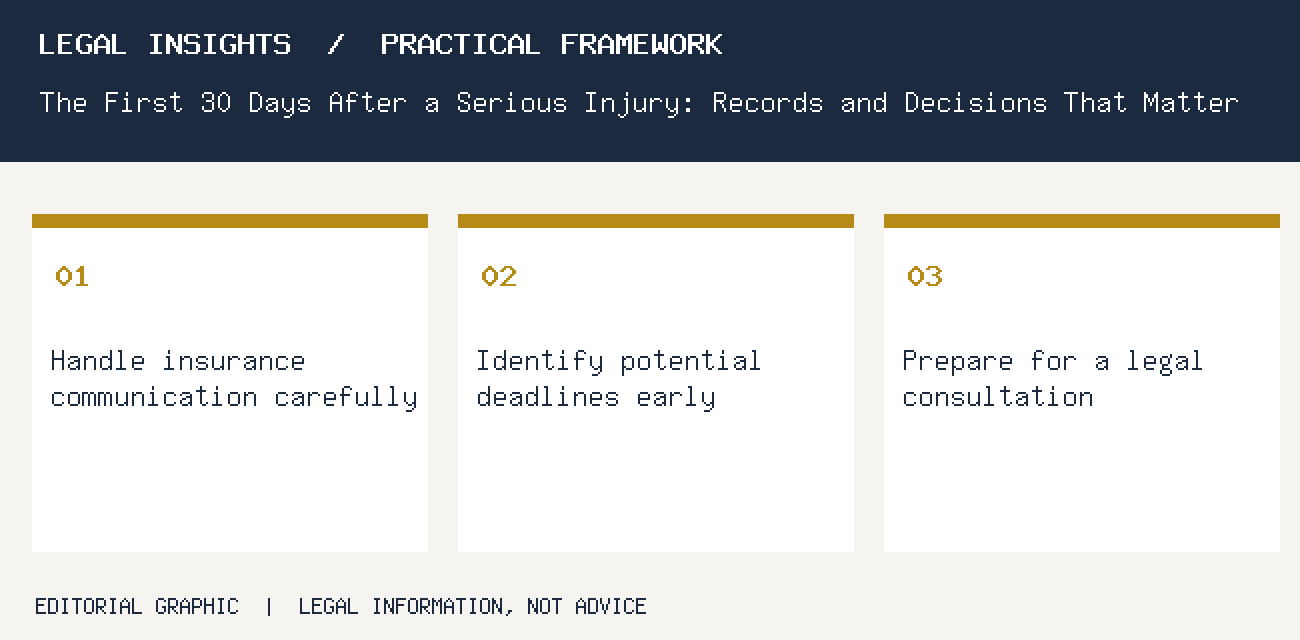
Handle insurance communication carefully
Different insurers may contact an injured person for different purposes and request information or statements.
Record names, dates, policy or claim references, letters and documents requested; clarify the recipient of each response. Costs and time commitments may affect the choice of next steps. Keep receipts, payments and estimates in separate categories and explain how figures were calculated. A financial spreadsheet is more persuasive when its entries can be traced to underlying statements.
A caller may represent the other party’s insurer rather than your own policy provider.
Do not assume every requested release or recorded statement is harmless; review obligations before consenting.
Identify potential deadlines early
Claims involving public agencies, private defendants or contract obligations may follow different time rules. Think about the decision this information supports.
Note incident dates, official notices, claim correspondence and any pending forms for prompt advice. Professional input can come from different fields. Medical professionals advise about treatment, engineers and construction experts assess technical conditions, and attorneys evaluate legal obligations and strategy. Their roles overlap in practical situations but should not be confused.
A public-entity injury claim may involve an administrative claim step on a shorter timeline than an ordinary civil case.
Do not calculate filing deadlines from a generic rule alone; exceptions and facts matter.
Prepare for a legal consultation
A focused meeting starts with facts, unanswered questions, practical goals and documents rather than a perfect legal theory.
Bring a one-page timeline, incident information, medical chronology, available receipts and a list of priority questions. A good next-step plan states who will act, what evidence or answer is expected, and when the issue will be revisited. It also records any reservations or uncertainties. This prevents an unresolved question from disappearing between meetings or follow-up messages.
An initial review can identify missing records and immediate decisions without guaranteeing an outcome.
Do not assume sending an unsolicited document creates an attorney-client relationship.
Practical records and decisions checklist
- First priorities: safety and medical attention: Seek appropriate medical evaluation, follow clinician instructions and document urgent steps when it is safe to do so.
- Write an early factual timeline: Write what you remember in chronological order and label uncertain details as estimates.
- Preserve photos and original files: Save original files, capture location and date where available, and create a separate working copy for sharing.
- Collect incident and witness information: Record reporting agency, report number if known, potential witnesses, and any lawful evidence source.
- Create a treatment chronology: Track dates, providers, instructions, medications as directed, referrals and functional changes in ordinary language.
- Track expenses without guessing: Save bills, statements, insurance explanations, receipts, pay records and notes of missed work.
- Handle insurance communication carefully: Record names, dates, policy or claim references, letters and documents requested; clarify the recipient of each response.
- Identify potential deadlines early: Note incident dates, official notices, claim correspondence and any pending forms for prompt advice.
- Prepare for a legal consultation: Bring a one-page timeline, incident information, medical chronology, available receipts and a list of priority questions.
Frequently asked questions
Should I contact a lawyer before finishing medical treatment?
A consultation can help identify potential deadlines and recordkeeping needs without dictating treatment decisions. Facts, medical advice when relevant, procedural requirements and applicable law should guide any personal decision.
What if I cannot obtain the report yet?
Keep the report reference and available evidence; do not postpone time-sensitive advice for one missing record.
Should I post photos of recovery on social media?
Consider privacy and evidence preservation before publishing potentially sensitive information.
Does an injury automatically create a legal claim?
No. Facts, responsibility, causation, damage and applicable law all require assessment.
Related pages
- Practice areas and legal services
- Answers to common legal questions
- More legal resources
- Contact for a case-specific consultation
Official reference: California Courts: deadlines to sue.
General educational information only. Nothing here is legal or medical advice, a guarantee of a result, or an attorney-client engagement. Seek qualified help for your individual circumstances and deadlines.
Your circumstances deserve a closer look
For questions involving personal injury, business disputes or construction matters, discuss the relevant facts and available options with counsel.