
Medical Records and Injury Claims: How to Build a Clear Treatment Timeline
Medical Records and Injury Claims: How to Build a Clear Treatment Timeline: practical guidance for organizing relevant information.
Medical records tell part of the story of an injury, but the paperwork often arrives from several places: emergency departments, imaging centers, specialists, therapists, pharmacies and insurers. The records may contain abbreviations and billing categories that are unfamiliar to a patient. A useful treatment timeline is not an attempt to reinterpret medical findings. It is a practical index of dates, providers, instructions and costs so you can ask informed questions and avoid losing documents needed for care or a legal review.
How to use this guide: Start with immediate safety or deadline needs. Then use the sections as a recordkeeping and consultation checklist. They describe practical information-gathering steps, not individualized legal or medical advice.
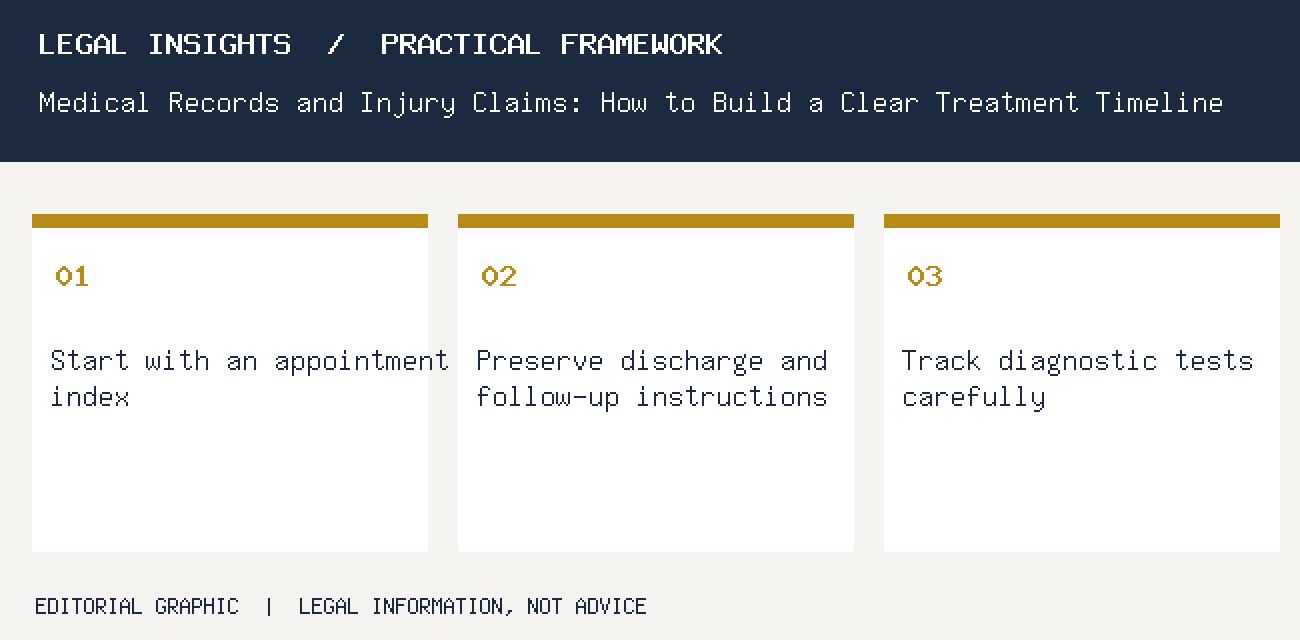
Start with an appointment index
Injury care may involve several providers who do not all share the same records or terminology. Focus on the narrow question rather than predicting the whole case. What happened, who observed it, what document is available, and what might explain the same event differently? A clear answer to those questions is more useful than an unsupported conclusion about fault.
Create a dated list of each appointment, provider, facility, visit purpose and any follow-up requested. Reliable records are easier to use when a neutral reader can find the original source of each assertion. Write the date beside the event, identify who provided the information, and distinguish a document from your memory of its meaning. The goal is clarity, not creating a more dramatic account.
A therapy visit may refer to an imaging result that is housed with a different provider. A careful account should identify the particular evidence, who supplied it and whether the sequence is agreed. If the source is incomplete, record the limitation instead of assuming the most favorable explanation is necessarily true.
Do not treat a personal summary as a replacement for the original clinical record. Consider which immediate action is appropriate and which issue needs a professional review. Keep decisions traceable to a source, note follow-up dates and avoid irreversible steps on the strength of an unverified assumption.
Preserve discharge and follow-up instructions
Instructions can identify medications, warning signs, activity restrictions and upcoming tests. Keep a working copy for collaboration and preserve the authentic record separately. Mark estimated dates, missing material and later amendments plainly. This makes follow-up easier when several people or institutions contribute information at different times.
Keep the full instruction pages and note when the next appointment was scheduled or changed. Urgent decisions can coexist with uncertainty. If safety, treatment or a formal notice needs attention, identify that first. Other questions may require follow-up documents or professional review. A working checklist helps prioritize tasks without claiming that every issue can be solved from the first file.
An emergency department may advise follow-up with a primary care clinician for continuing symptoms.
Do not change medications or disregard clinical advice based on a legal article.
Track diagnostic tests carefully
Imaging, laboratory reports and specialist opinions may be stored in multiple formats. The relevant facts may change as new records become available. Record the current understanding and the source for it; revisit the issue when evidence is added. A practical timeline should help communication, not lock you into a claim before review.
Record test dates, ordering professionals, report availability and where original files can be requested. Information about a person’s health, financial situation or private communications deserves careful handling. Share only what is appropriate through secure channels, and avoid unnecessary public circulation. Preserving a record is not the same as making it available to everyone who asks.
A radiology report and the actual imaging file may be separately accessible through a hospital portal.
Avoid interpreting medical images independently or describing a tentative finding as a definitive diagnosis.
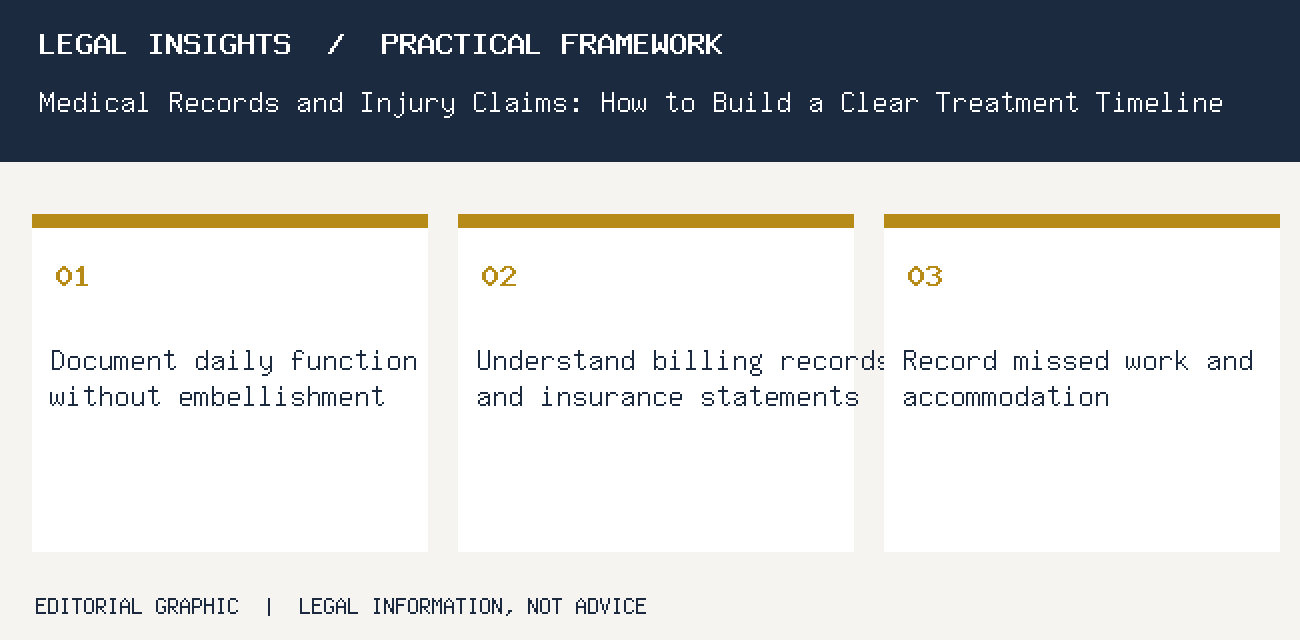
Document daily function without embellishment
An injury can affect ordinary tasks even when a medical chart focuses on diagnosis and treatment. Think about the decision this information supports. It may help identify a provider, answer an insurer, preserve evidence, assess a contract or prepare for counsel. When an action could be difficult to reverse, obtain appropriate advice first.
Keep brief, dated notes about work, sleep, mobility and activities, using measured and accurate descriptions. A useful summary can acknowledge missing facts without weakening the commitment to accuracy. Write unknown where the timing or source cannot presently be verified. If an estimate is necessary, label it as such. Later corrections should be documented rather than replacing the original note.
A patient might record that lifting groceries was difficult on a specific date rather than claiming total incapacity.
Do not create a diary solely to exaggerate limitations or obscure good days.
Understand billing records and insurance statements
A provider bill, an insurer’s explanation of benefits and the amount actually paid can differ.
Keep all documents and label them by provider, date, amount billed, adjustments, payments and remaining balance. People frequently confuse a factual observation with a conclusion about legal responsibility. An incident report, image or invoice may support a piece of the timeline but not every element of a legal claim. Identifying the limits of each source helps prevent overconfidence.
A facility may send more than one statement for services related to the same visit.
Do not assume a charge appearing twice is necessarily double billing without checking account references.
Record missed work and accommodation
Lost workdays and modified duties often require records beyond a patient’s recollection.
Keep schedules, payroll statements, employer notices and any clinician-supported work restrictions. A practical conversation with counsel should identify your goals, the decisions you face and any deadlines that could alter your options. Bring the strongest available records rather than a large folder without an index. Ask what is missing and how additional evidence should be preserved.
A person on reduced hours may need to distinguish lost wages from unpaid leave or other benefits.
Do not represent the full salary as lost when only certain shifts or earnings were affected.
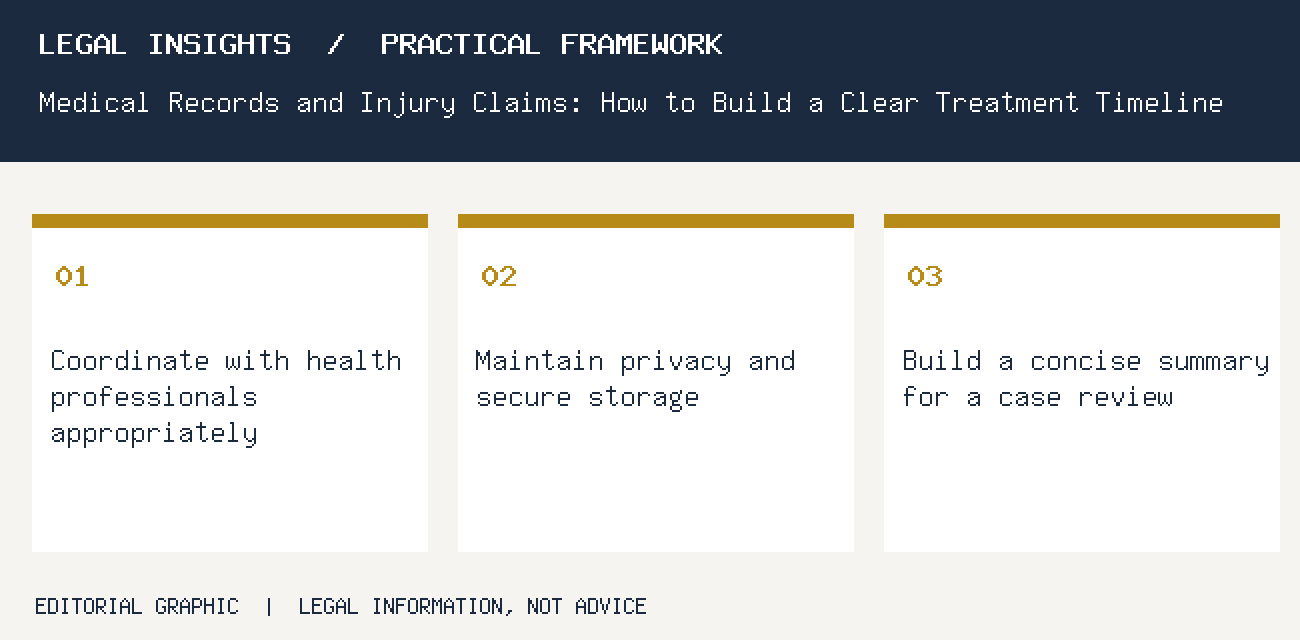
Coordinate with health professionals appropriately
Medical questions belong with licensed clinicians, while legal questions about claims belong with qualified counsel.
Ask providers about unclear records, corrections, referrals and appropriate requests for copies. Costs and time commitments may affect the choice of next steps. Keep receipts, payments and estimates in separate categories and explain how figures were calculated. A financial spreadsheet is more persuasive when its entries can be traced to underlying statements.
A patient may discover a clerical date error and ask the record custodian for its formal correction procedure.
Do not alter clinical records yourself or request inaccurate diagnoses for a lawsuit.
Maintain privacy and secure storage
Medical files contain sensitive information that should not be circulated casually to employers or unrelated third parties. Think about the decision this information supports.
Use secure portals where possible and follow provider procedures for authorization and disclosure. Professional input can come from different fields. Medical professionals advise about treatment, engineers and construction experts assess technical conditions, and attorneys evaluate legal obligations and strategy. Their roles overlap in practical situations but should not be confused.
A forwarded screenshot can expose personal identifiers that were not needed for the recipient’s purpose.
Do not post complete medical records to social media or public upload forms.
Build a concise summary for a case review
A readable timeline points a reviewer toward original documents rather than reciting every medical detail.
Prepare date, provider, reason for care, record location, available bill and open question columns. A good next-step plan states who will act, what evidence or answer is expected, and when the issue will be revisited. It also records any reservations or uncertainties. This prevents an unresolved question from disappearing between meetings or follow-up messages.
An attorney can then ask about missing appointments or unclear expenses without treating a summary as proof.
Do not promise that a particular treatment pattern guarantees a particular settlement.
Practical records and decisions checklist
- Start with an appointment index: Create a dated list of each appointment, provider, facility, visit purpose and any follow-up requested.
- Preserve discharge and follow-up instructions: Keep the full instruction pages and note when the next appointment was scheduled or changed.
- Track diagnostic tests carefully: Record test dates, ordering professionals, report availability and where original files can be requested.
- Document daily function without embellishment: Keep brief, dated notes about work, sleep, mobility and activities, using measured and accurate descriptions.
- Understand billing records and insurance statements: Keep all documents and label them by provider, date, amount billed, adjustments, payments and remaining balance.
- Record missed work and accommodation: Keep schedules, payroll statements, employer notices and any clinician-supported work restrictions.
- Coordinate with health professionals appropriately: Ask providers about unclear records, corrections, referrals and appropriate requests for copies.
- Maintain privacy and secure storage: Use secure portals where possible and follow provider procedures for authorization and disclosure.
- Build a concise summary for a case review: Prepare date, provider, reason for care, record location, available bill and open question columns.
Frequently asked questions
Can I request copies of my medical records?
Patients generally have access rights subject to applicable law and provider processes; ask the records department how to request them. Facts, medical advice when relevant, procedural requirements and applicable law should guide any personal decision.
What if a medical note contains an error?
Ask the provider about formal amendment or correction procedures rather than altering the original.
Should I share every record with an insurer?
Clarify the request and your obligations with appropriate professional advice before signing broad releases.
Will missed appointments decide my case?
A gap can raise questions, but its significance depends on the reasons, full medical picture and applicable law.
Related pages
- Practice areas and legal services
- Answers to common legal questions
- More legal resources
- Contact for a case-specific consultation
Official reference: California Courts: civil evidence and discovery.
General educational information only. Nothing here is legal or medical advice, a guarantee of a result, or an attorney-client engagement. Seek qualified help for your individual circumstances and deadlines.
Your circumstances deserve a closer look
For questions involving personal injury, business disputes or construction matters, discuss the relevant facts and available options with counsel.