
Injured on Public Property in California? Why Government Claim Notices Matter
Injured on Public Property in California? Why Government Claim Notices Matter: practical guidance for organizing relevant information.
An incident involving a public sidewalk, bus, public facility or government vehicle may raise questions that are different from a private injury claim. The responsible entity is not always obvious, and California’s Government Claims Act can require a claim to be presented before a lawsuit. Deadlines can be short and exceptions exist. This guide explains the records and questions to organize promptly, without attempting to decide liability or calculate a deadline for any particular person.
How to use this guide: Start with immediate safety or deadline needs. Then use the sections as a recordkeeping and consultation checklist. They describe practical information-gathering steps, not individualized legal or medical advice.
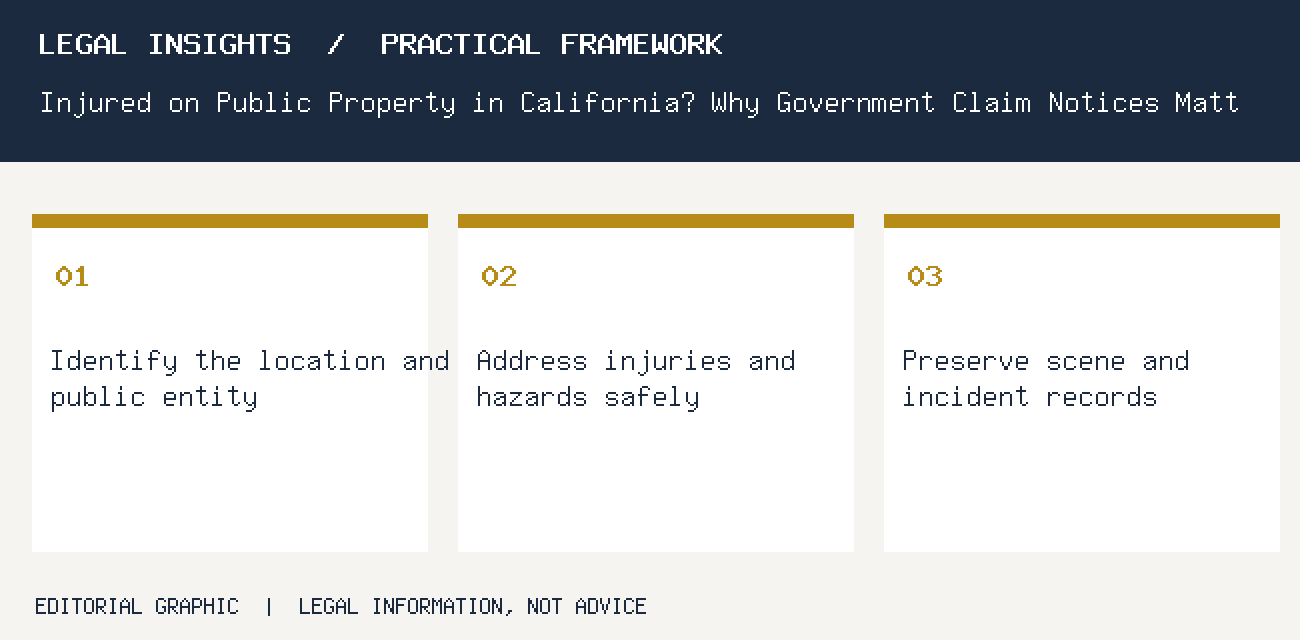
Identify the location and public entity
A place that looks public may have overlapping city, county, state or private responsibilities. Focus on the narrow question rather than predicting the whole case. What happened, who observed it, what document is available, and what might explain the same event differently? A clear answer to those questions is more useful than an unsupported conclusion about fault.
Document exact location, address, direction of travel, nearby signs, facility name and relevant maps. Reliable records are easier to use when a neutral reader can find the original source of each assertion. Write the date beside the event, identify who provided the information, and distinguish a document from your memory of its meaning. The goal is clarity, not creating a more dramatic account.
A walkway adjacent to a public building might involve maintenance arrangements that are not obvious from appearance. A careful account should identify the particular evidence, who supplied it and whether the sequence is agreed. If the source is incomplete, record the limitation instead of assuming the most favorable explanation is necessarily true.
Do not assume the agency receiving a phone complaint is necessarily the proper legal claims recipient. Consider which immediate action is appropriate and which issue needs a professional review. Keep decisions traceable to a source, note follow-up dates and avoid irreversible steps on the strength of an unverified assumption.
Address injuries and hazards safely
Immediate medical needs and preventing further harm should remain the priority after an incident. Keep a working copy for collaboration and preserve the authentic record separately. Mark estimated dates, missing material and later amendments plainly. This makes follow-up easier when several people or institutions contribute information at different times.
Seek appropriate help and record any emergency response or temporary safety measures that occur. Urgent decisions can coexist with uncertainty. If safety, treatment or a formal notice needs attention, identify that first. Other questions may require follow-up documents or professional review. A working checklist helps prioritize tasks without claiming that every issue can be solved from the first file.
A hazard may be repaired soon after an event, so safe, timely photographs can preserve what was visible.
Do not re-enter dangerous conditions to obtain evidence or interfere with repairs.
Preserve scene and incident records
Conditions, lighting, weather, warning signs and witness observations may matter to factual analysis. The relevant facts may change as new records become available. Record the current understanding and the source for it; revisit the issue when evidence is added. A practical timeline should help communication, not lock you into a claim before review.
Save original photographs, video, reporting records, witness contacts and your factual timeline. Information about a person’s health, financial situation or private communications deserves careful handling. Share only what is appropriate through secure channels, and avoid unnecessary public circulation. Preserving a record is not the same as making it available to everyone who asks.
A bus camera or nearby business recording may have a retention period unrelated to a legal filing deadline.
Do not assume the existence of surveillance footage or demand unauthorized access to restricted records.
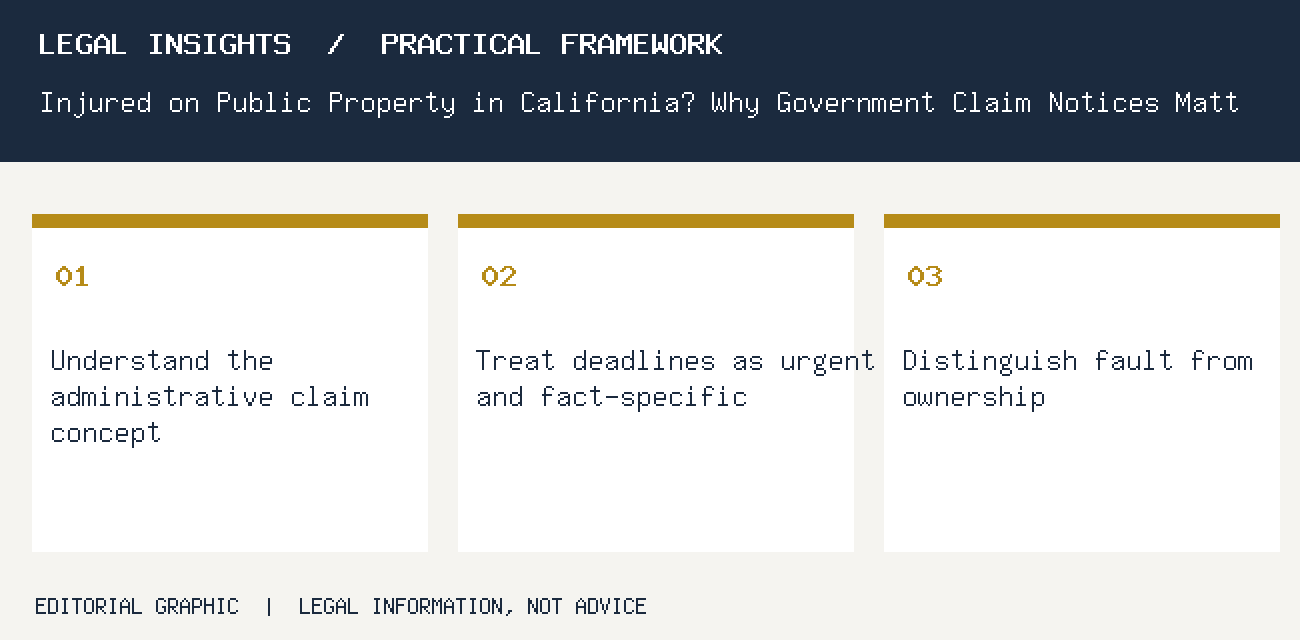
Understand the administrative claim concept
California Courts explains that a government claim generally must be filed with the relevant agency before suing it. Think about the decision this information supports. It may help identify a provider, answer an insurer, preserve evidence, assess a contract or prepare for counsel. When an action could be difficult to reverse, obtain appropriate advice first.
Identify the possible agency, claim form, delivery method, event date and requested information for counsel. A useful summary can acknowledge missing facts without weakening the commitment to accuracy. Write unknown where the timing or source cannot presently be verified. If an estimate is necessary, label it as such. Later corrections should be documented rather than replacing the original note.
The process for a city claim may not be identical to the process for a state agency.
Do not treat an ordinary customer-service email as a substitute for a required formal claim.
Treat deadlines as urgent and fact-specific
California Courts notes a six-month presentation period for many personal injury claims against public entities, with exceptions.
Write down the incident date and seek case-specific deadline advice promptly rather than waiting for every bill. People frequently confuse a factual observation with a conclusion about legal responsibility. An incident report, image or invoice may support a piece of the timeline but not every element of a legal claim. Identifying the limits of each source helps prevent overconfidence.
A claimant might still be receiving care when an administrative notice deadline arrives.
Do not assume the ordinary personal-injury filing period also controls every government-claim requirement.
Distinguish fault from ownership
Public ownership does not alone show negligence, notice of a hazard or the legal standard governing the incident.
Collect descriptions of the condition and any prior complaints or maintenance facts that are lawfully available. A practical conversation with counsel should identify your goals, the decisions you face and any deadlines that could alter your options. Bring the strongest available records rather than a large folder without an index. Ask what is missing and how additional evidence should be preserved.
A sidewalk defect may require investigation of its cause, visibility, maintenance and responsible parties.
Do not conclude liability from photographs without reviewing the larger facts and applicable defenses.
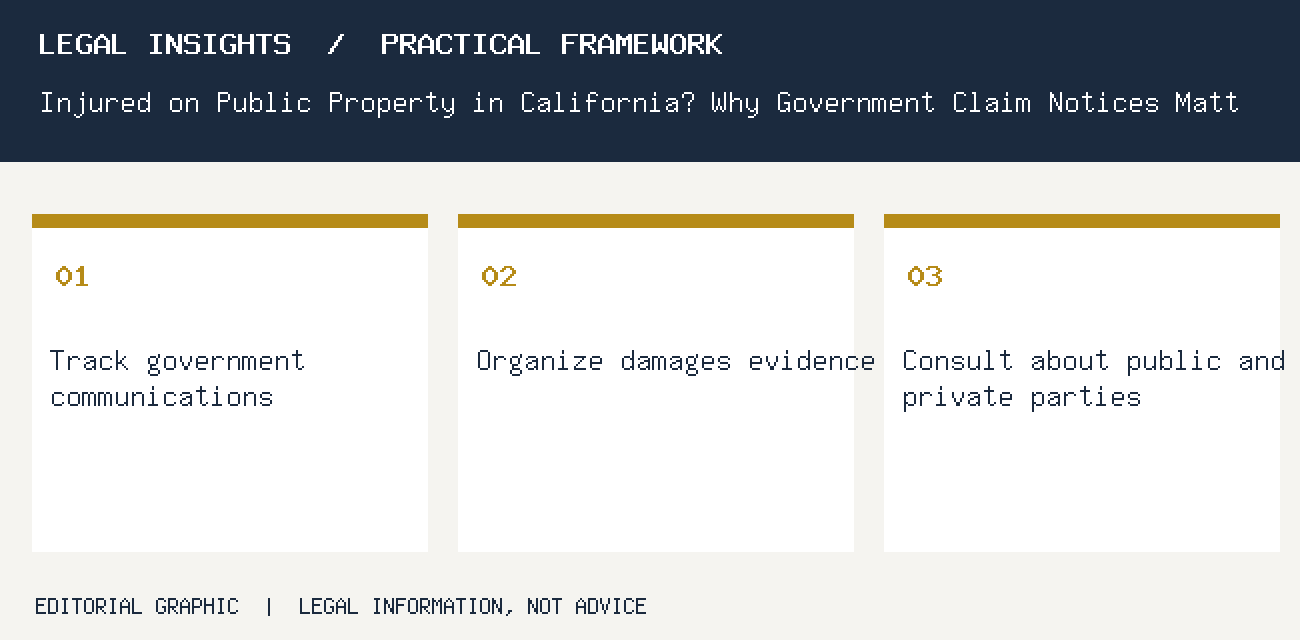
Track government communications
Agency responses, acknowledgments, requests for information and rejections can affect procedural choices.
Retain full correspondence, envelopes, timestamps, claim numbers and proof of submission. Costs and time commitments may affect the choice of next steps. Keep receipts, payments and estimates in separate categories and explain how figures were calculated. A financial spreadsheet is more persuasive when its entries can be traced to underlying statements.
A rejection letter may create a new deadline that should be recorded immediately.
Do not rely on a phone representative’s verbal assurance as proof that a filing requirement has been met.
Organize damages evidence
Injury-related costs, missed work, treatment and other claimed impacts require documentation. Think about the decision this information supports.
Preserve medical records, bills, pay statements, travel receipts and reasonable contemporaneous notes. Professional input can come from different fields. Medical professionals advise about treatment, engineers and construction experts assess technical conditions, and attorneys evaluate legal obligations and strategy. Their roles overlap in practical situations but should not be confused.
A claimed wage loss should reconcile with employer records rather than a round estimate.
Do not inflate or invent amounts to make a claim appear more significant.
Consult about public and private parties
A single event can involve more than one potentially responsible party and more than one legal process.
Bring a location map, timeline, possible entity names, records and agency correspondence to counsel. A good next-step plan states who will act, what evidence or answer is expected, and when the issue will be revisited. It also records any reservations or uncertainties. This prevents an unresolved question from disappearing between meetings or follow-up messages.
An injury near a construction zone may raise questions about a public owner and a private contractor.
Do not assume one notice or lawsuit automatically preserves claims against every party.
Practical records and decisions checklist
- Identify the location and public entity: Document exact location, address, direction of travel, nearby signs, facility name and relevant maps.
- Address injuries and hazards safely: Seek appropriate help and record any emergency response or temporary safety measures that occur.
- Preserve scene and incident records: Save original photographs, video, reporting records, witness contacts and your factual timeline.
- Understand the administrative claim concept: Identify the possible agency, claim form, delivery method, event date and requested information for counsel.
- Treat deadlines as urgent and fact-specific: Write down the incident date and seek case-specific deadline advice promptly rather than waiting for every bill.
- Distinguish fault from ownership: Collect descriptions of the condition and any prior complaints or maintenance facts that are lawfully available.
- Track government communications: Retain full correspondence, envelopes, timestamps, claim numbers and proof of submission.
- Organize damages evidence: Preserve medical records, bills, pay statements, travel receipts and reasonable contemporaneous notes.
- Consult about public and private parties: Bring a location map, timeline, possible entity names, records and agency correspondence to counsel.
Frequently asked questions
What is a California government claim?
It is generally an administrative presentation to the government before certain lawsuits, subject to specific rules and exceptions. Facts, medical advice when relevant, procedural requirements and applicable law should guide any personal decision.
Is the deadline always six months?
No. The type of claim, exceptions and other circumstances can change applicable deadlines.
What if the agency has not responded?
Different consequences can follow a response or lack of response; seek prompt advice using the actual submission dates.
Can a private contractor also be involved?
Possibly. The responsible parties and applicable legal theories require fact-specific investigation.
Related pages
- Practice areas and legal services
- Answers to common legal questions
- More legal resources
- Contact for a case-specific consultation
Official reference: California Courts government claims guide.
General educational information only. Nothing here is legal or medical advice, a guarantee of a result, or an attorney-client engagement. Seek qualified help for your individual circumstances and deadlines.
Your circumstances deserve a closer look
For questions involving personal injury, business disputes or construction matters, discuss the relevant facts and available options with counsel.