
Before a Small Business Lawsuit: How to Organize Evidence, Costs, and Options
Before a Small Business Lawsuit: How to Organize Evidence, Costs, and Options: practical guidance for organizing relevant information.
When a customer refuses payment, a partner threatens litigation or a supplier allegedly violates an agreement, the business owner may feel that filing suit is the only remaining way to be heard. Litigation can be appropriate in some disputes, but the decision should begin with the contract, facts, evidence, realistic costs and alternatives. This guide is designed for owners who want to prepare a useful file and a focused first legal conversation rather than decide a case through assumptions.
How to use this guide: Start with immediate safety or deadline needs. Then use the sections as a recordkeeping and consultation checklist. They describe practical information-gathering steps, not individualized legal or medical advice.
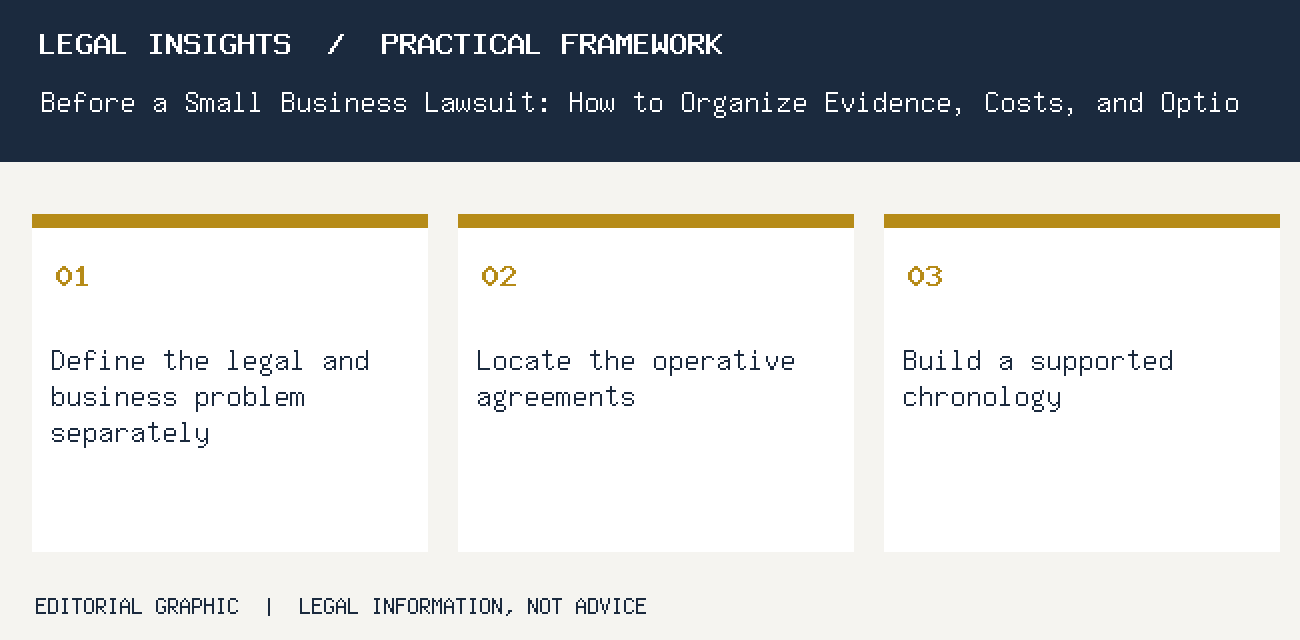
Define the legal and business problem separately
The business injury may include customer strain or interruption even when the potentially enforceable claim is narrower. Focus on the narrow question rather than predicting the whole case. What happened, who observed it, what document is available, and what might explain the same event differently? A clear answer to those questions is more useful than an unsupported conclusion about fault.
Describe the disputed promise, events, money at issue and operational harm in separate sentences. Reliable records are easier to use when a neutral reader can find the original source of each assertion. Write the date beside the event, identify who provided the information, and distinguish a document from your memory of its meaning. The goal is clarity, not creating a more dramatic account.
A former vendor’s late delivery may be upsetting, but the key contractual questions involve specific duties and provable losses. A careful account should identify the particular evidence, who supplied it and whether the sequence is agreed. If the source is incomplete, record the limitation instead of assuming the most favorable explanation is necessarily true.
Do not equate frustration or reputational concern automatically with damages recoverable in a lawsuit. Consider which immediate action is appropriate and which issue needs a professional review. Keep decisions traceable to a source, note follow-up dates and avoid irreversible steps on the strength of an unverified assumption.
Locate the operative agreements
Written signatures, later amendments and incorporated terms determine what the parties actually accepted. Keep a working copy for collaboration and preserve the authentic record separately. Mark estimated dates, missing material and later amendments plainly. This makes follow-up easier when several people or institutions contribute information at different times.
Gather signed contracts, purchase orders, statements of work, policy references and modifications. Urgent decisions can coexist with uncertainty. If safety, treatment or a formal notice needs attention, identify that first. Other questions may require follow-up documents or professional review. A working checklist helps prioritize tasks without claiming that every issue can be solved from the first file.
An email proposal may be superseded by a later executed agreement with different payment milestones.
Do not cite a template version that was never signed as controlling proof.
Build a supported chronology
A lawsuit may depend on when a duty arose, when the alleged failure happened and what followed. The relevant facts may change as new records become available. Record the current understanding and the source for it; revisit the issue when evidence is added. A practical timeline should help communication, not lock you into a claim before review.
Write a dated event list, attaching a source for every significant entry. Information about a person’s health, financial situation or private communications deserves careful handling. Share only what is appropriate through secure channels, and avoid unnecessary public circulation. Preserving a record is not the same as making it available to everyone who asks.
A payment dispute may require tracking both acceptance of work and an agreed extension of the invoice deadline.
Do not backdate records or hide messages that appear inconsistent with your position.
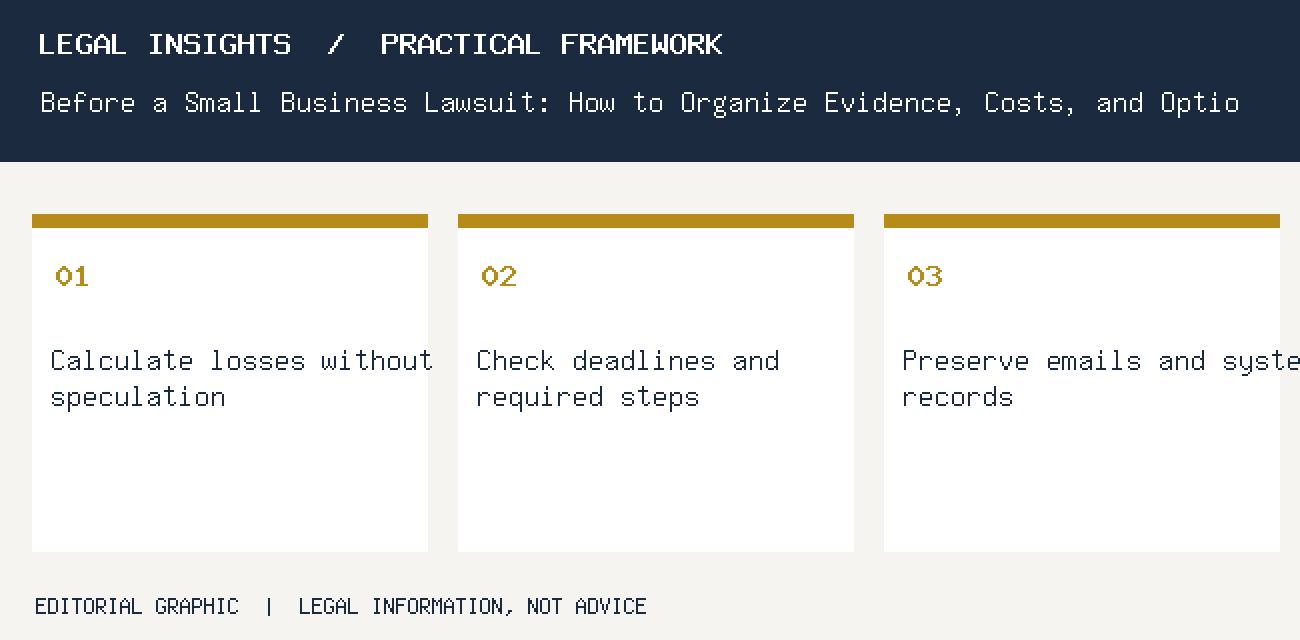
Calculate losses without speculation
Financial claims often include unpaid amounts, replacement costs, credits or projected revenue impacts. Think about the decision this information supports. It may help identify a provider, answer an insurer, preserve evidence, assess a contract or prepare for counsel. When an action could be difficult to reverse, obtain appropriate advice first.
Reconcile invoices, bank records, accounting entries, mitigation expenses and underlying assumptions. A useful summary can acknowledge missing facts without weakening the commitment to accuracy. Write unknown where the timing or source cannot presently be verified. If an estimate is necessary, label it as such. Later corrections should be documented rather than replacing the original note.
An estimated future sale should not be recorded as a completed sale that was lost.
Do not include the same cost under multiple labels or claim hypothetical amounts as actual payments.
Check deadlines and required steps
California civil cases have different limitations periods and a contract can contain dispute escalation provisions.
Identify dates for breach, discovery, notices, mediation and any filed papers for advice. People frequently confuse a factual observation with a conclusion about legal responsibility. An incident report, image or invoice may support a piece of the timeline but not every element of a legal claim. Identifying the limits of each source helps prevent overconfidence.
California Courts describes different general periods for written and oral contract claims, subject to facts and exceptions.
Do not assume an ongoing negotiation or partial payment automatically extends every deadline.
Preserve emails and system records
Business evidence often sits in CRM entries, finance systems, chats, devices or third-party platforms.
Maintain originals and exports with their context, authors, dates and version history. A practical conversation with counsel should identify your goals, the decisions you face and any deadlines that could alter your options. Bring the strongest available records rather than a large folder without an index. Ask what is missing and how additional evidence should be preserved.
An account manager’s ticket notes may explain why a customer withheld payment.
Do not delete inconvenient messages or edit the only copy after litigation is reasonably foreseeable.
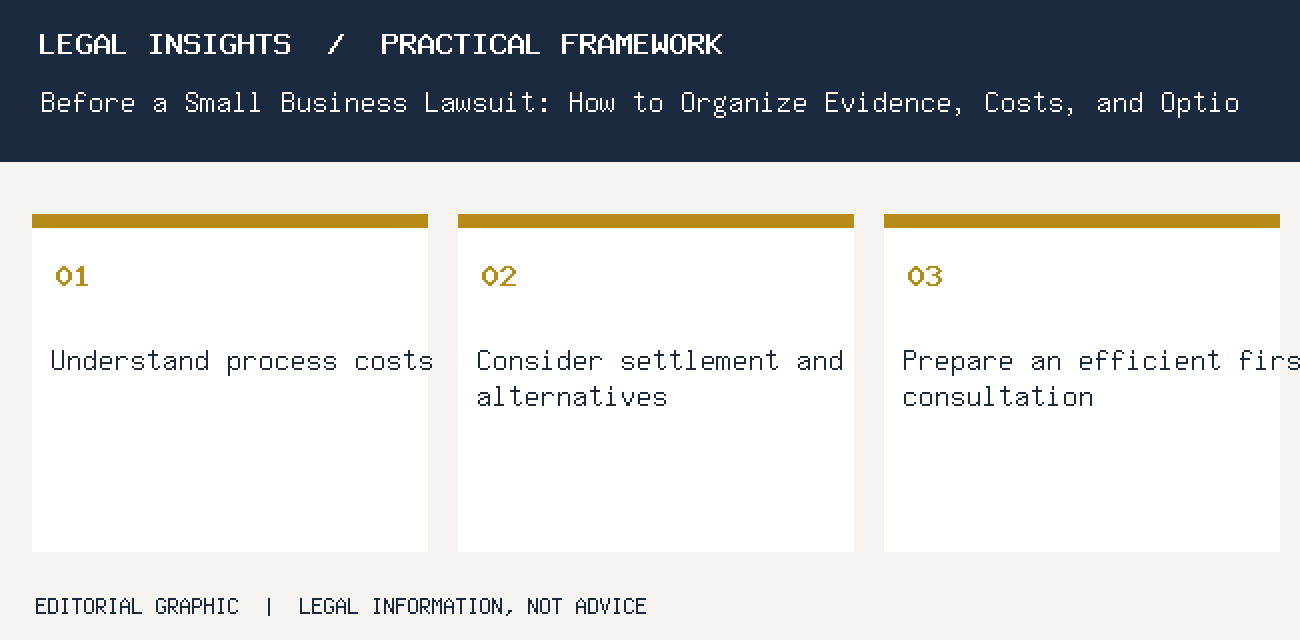
Understand process costs
The potential recovery is only one part of a rational business decision about a dispute.
Discuss legal fees, time away from operations, discovery effort, expert costs and collection risk with counsel. Costs and time commitments may affect the choice of next steps. Keep receipts, payments and estimates in separate categories and explain how figures were calculated. A financial spreadsheet is more persuasive when its entries can be traced to underlying statements.
Even a favorable judgment may take further work to enforce or collect.
Do not assume litigation automatically pays for itself or guarantees attorney-fee recovery.
Consider settlement and alternatives
Direct negotiations, a structured demand, mediation or contract-required arbitration may offer different tradeoffs. Think about the decision this information supports.
Evaluate what each option could resolve and whether the decision-maker can approve a binding result. Professional input can come from different fields. Medical professionals advise about treatment, engineers and construction experts assess technical conditions, and attorneys evaluate legal obligations and strategy. Their roles overlap in practical situations but should not be confused.
A phased payment plan may preserve a customer relationship while resolving a disputed balance.
Do not sign broad releases without understanding which parties and claims are included.
Prepare an efficient first consultation
An attorney can evaluate a matter more effectively with concise facts and a small index of the most relevant records.
Bring a timeline, agreements, disputed amounts, key correspondence and a list of desired outcomes. A good next-step plan states who will act, what evidence or answer is expected, and when the issue will be revisited. It also records any reservations or uncertainties. This prevents an unresolved question from disappearing between meetings or follow-up messages.
A practical goal might be preserving a client relationship rather than maximizing an uncertain court claim.
Do not withhold important facts simply because they complicate the case.
Practical records and decisions checklist
- Define the legal and business problem separately: Describe the disputed promise, events, money at issue and operational harm in separate sentences.
- Locate the operative agreements: Gather signed contracts, purchase orders, statements of work, policy references and modifications.
- Build a supported chronology: Write a dated event list, attaching a source for every significant entry.
- Calculate losses without speculation: Reconcile invoices, bank records, accounting entries, mitigation expenses and underlying assumptions.
- Check deadlines and required steps: Identify dates for breach, discovery, notices, mediation and any filed papers for advice.
- Preserve emails and system records: Maintain originals and exports with their context, authors, dates and version history.
- Understand process costs: Discuss legal fees, time away from operations, discovery effort, expert costs and collection risk with counsel.
- Consider settlement and alternatives: Evaluate what each option could resolve and whether the decision-maker can approve a binding result.
- Prepare an efficient first consultation: Bring a timeline, agreements, disputed amounts, key correspondence and a list of desired outcomes.
Frequently asked questions
Do I need a written contract to have a dispute?
Not always, but proof and applicable deadlines can differ among written, oral and implied arrangements. Facts, medical advice when relevant, procedural requirements and applicable law should guide any personal decision.
Is small claims court always the best choice for a low-value dispute?
Suitability depends on parties, claim type, amount, procedure and the desired remedy.
Can I file without demanding payment first?
The answer depends on claim type, contract terms and applicable rules; a targeted review is useful.
What about attorney fees?
Fee recovery is not automatic; contracts, statutes and case-specific rules can matter.
Related pages
- Practice areas and legal services
- Answers to common legal questions
- More legal resources
- Contact for a case-specific consultation
Official reference: California Courts breach of contract overview.
General educational information only. Nothing here is legal or medical advice, a guarantee of a result, or an attorney-client engagement. Seek qualified help for your individual circumstances and deadlines.
Your circumstances deserve a closer look
For questions involving personal injury, business disputes or construction matters, discuss the relevant facts and available options with counsel.